Vem daterade Françoise Athénaïs de Rochechouart de Montespan?
Ludvig XIV av Frankrike daterad Françoise Athénaïs de Rochechouart de Montespan från ? till ?. Åldersskillnaden var 2 år, 1 månader och 0 dagar.
Françoise Athénaïs de Rochechouart de Montespan

Françoise "Athénaïs" de Rochechouart de Mortemart, Markisinnan de Montespan, allmänt kallad Madame de Montespan, född 5 oktober 1640 i Lussac-les-Châteaux, död 27 maj 1707, var en fransk markisinna och hovfunktionär.
Hon var mätress, maîtresse-en-titre, till Ludvig XIV mellan 1667 och 1678. Hon efterträdde den tidigare mätressen Louise de la Vallière. Med Ludvig fick hon åtta barn, vilka uppfostrades av hennes efterträdare Madame de Maintenon. Madame de Montespan är känd för sin skönhet, praktlystnad och slösaktighet. Under sin tid som kunglig maîtresse-en-titre utövade hon stort kulturellt inflytande, och kallades en tid "Frankrikes sanna drottning".
Hennes förhållande med kungen avslutades då kungen ersatte henne med Marie-Angelique de Fontanges strax före stora skandal som blev känd som Giftmordsaffären, där hon implicerades för att ha anlitat svartkonstnärer och giftblandare för att uppnå och bibehålla sin ställning som kungens älskarinna, utan att någonsin ställas inför rätta. Hon fortsatte dock att bo kvar vid hovet i ytterligare elva år, innan hon 1691 lämnade hovet.
Läs mer...Ludvig XIV av Frankrike
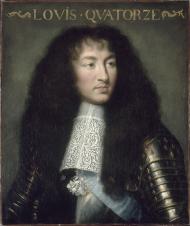
Louis XIV (Louis-Dieudonné; 5 September 1638 – 1 September 1715), also known as Louis the Great (Louis le Grand [lwi lə ɡʁɑ̃]) or the Sun King (le Roi Soleil [lə ʁwa sɔlɛj]), was King of France from 1643 until his death in 1715. His reign of 72 years and 110 days is the longest of any monarch in history. An emblem of the age of absolutism in Europe, Louis XIV's legacy includes French colonial expansion, the conclusion of the Thirty Years' War involving the Habsburgs, and a controlling influence on the style of fine arts and architecture in France, including the transformation of the Palace of Versailles into a center of royal power and politics. Louis XIV's pageantry and opulence helped define the French Baroque style of art and architecture and promoted his image as supreme leader of France in the early modern period.
Louis XIV began his personal rule of France in 1661 after the death of his chief minister Cardinal Mazarin. A believer in the divine right of kings, Louis XIV continued Louis XIII's work of creating a centralized state governed from a capital. Louis XIV sought to eliminate the remnants of feudalism persisting in parts of France by compelling many members of the nobility to reside at his lavish Palace of Versailles. In doing so, he succeeded in pacifying the aristocracy, many of whom had participated in the Fronde rebellions during his minority. He consolidated a system of absolute monarchy in France that endured until the French Revolution. Louis XIV enforced uniformity of religion under the Catholic Church. His revocation of the Edict of Nantes abolished the rights of the Huguenot Protestant minority and subjected them to a wave of dragonnades, effectively forcing Huguenots to emigrate or convert, virtually destroying the French Protestant community.
During Louis' long reign, France emerged as the leading European power and regularly made war. A conflict with Spain marked his entire childhood, while during his personal rule, Louis fought three major continental conflicts, each against powerful foreign alliances: the Franco-Dutch War, the Nine Years' War, and the War of the Spanish Succession. In addition, France contested shorter wars such as the War of Devolution and the War of the Reunions. Warfare defined Louis's foreign policy, impelled by his personal ambition for glory and power: "a mix of commerce, revenge, and pique". His wars strained France's resources to the utmost, while in peacetime he concentrated on preparing for the next war. He taught his diplomats that their job was to create tactical and strategic advantages for the French military. Upon his death in 1715, Louis XIV left his great-grandson and successor, Louis XV, a powerful but war-weary kingdom, in major debt after the War of the Spanish Succession that had raged on since 1701.
Some of his other notable achievements include the construction of the 240 km (150 mi) Canal du Midi in Southern France, the patronage of artists (the playwrights Molière, Racine, the man of letters Boileau, the composer and dancer Lully, the painter Le Brun and the landscape architect Le Nôtre, all contributed to the apogee of French classicism, described during his lifetime as the "Grand Siècle", or even "the century of Louis XIV"), and the founding of the French Academy of Sciences.
Läs mer...