Vem daterade Germaine de Staël?
Benjamin Constant daterad Germaine de Staël från ? till ?. Åldersskillnaden var 1 år, 6 månader och 3 dagar.
Louis, comte de Narbonne-Lara daterad Germaine de Staël från ? till ?. Åldersskillnaden var 11 år, 1 månader och 2 dagar.
Charles-Maurice de Talleyrand-Périgord daterad Germaine de Staël från ? till ?. Åldersskillnaden var 12 år, 2 månader och 20 dagar.
Germaine de Staël
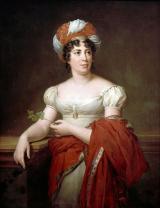
Anne-Louise Germaine de Staël-Holstein (Madame de Staël), född 22 april 1766 i Paris, död 14 juli 1817 i Paris, var en fransk författare och salongsvärd. Hon skrev också sina memoarskildringar om tiden under franska revolutionen.
Läs mer...Benjamin Constant
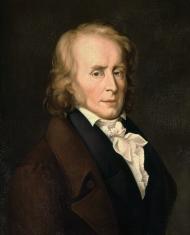
Henri-Benjamin Constant de Rebecque, född 25 oktober 1767 i Lausanne, död 8 december 1830 i Paris, var en politisk teoretiker, författare och politiker i Frankrike.
Läs mer...Germaine de Staël
Louis, comte de Narbonne-Lara
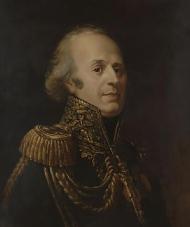
Louis Marie Jacques Almaric de Narbonne-Lara, född 17 augusti 1755, död 17 november 1813, var en fransk greve, militär och diplomat.
Narbonne-Lara uppfostrades vid franska hovet men var anhängare av upplysningsfilosofin, anslöt sig 1789 till franska revolutionen och blev en av ledarna för det konstitutionella partiet. Genom Germaine de Staëls inflytande blev han krigsminister 1791 men avskedades i mars 1792, emigrerade och uppehöll sig från 1793 i Schweiz och Tyskland. Efter Brumairekuppen återkom han till Frankrike, utnämndes till general och blev 1809 guvernör i Trieste. 1813 blev han ambassadör i Wien.
Läs mer...Germaine de Staël
Charles-Maurice de Talleyrand-Périgord

Charles-Maurice de Talleyrand-Périgord (; French: [ʃaʁl mɔʁis də tal(ɛ)ʁɑ̃ peʁiɡɔʁ, moʁ-]; 2 February 1754 – 17 May 1838), 1st Prince of Benevento, then Prince of Talleyrand, was a French secularized clergyman, statesman, and leading diplomat. After studying theology, he became Agent-General of the Clergy in 1780. In 1789, just before the French Revolution, he became Bishop of Autun. He worked at the highest levels of successive French governments, most commonly as foreign minister or in some other diplomatic capacity. He served as the French representative to the Congress of Vienna. His career spanned the regimes of Louis XVI, the years of the French Revolution, Napoleon, Louis XVIII, Charles X, and Louis Philippe I. Those Talleyrand served often distrusted him but found him extremely useful. The name "Talleyrand" has become a byword for crafty and cynical diplomacy.
Talleyrand was Napoleon's chief diplomat during the years when French military victories brought one European state after another under French hegemony. Most of the time, he worked for peace so as to consolidate France's gains. He succeeded in obtaining peace with Austria through the 1801 Treaty of Lunéville and with Britain in the 1802 Treaty of Amiens. He could not prevent the renewal of war in 1803 but by 1805 he opposed his emperor's renewed wars against Austria, Prussia, and Russia. He resigned as foreign minister in August 1807, but retained the trust of Napoleon. He conspired to undermine the emperor's plans through secret dealings with Tsar Alexander I of Russia and the Austrian minister Klemens von Metternich. Talleyrand sought a negotiated secure peace so as to perpetuate the gains of the French Revolution. Napoleon rejected peace; when he fell in 1814, Talleyrand supported the Bourbon Restoration decided by the Allies. He played a major role at the Congress of Vienna in 1814–1815, where he negotiated a favorable settlement for France and played a role in unwinding the Napoleonic Wars.
Talleyrand polarizes opinion. Some regard him as one of the most versatile, skilled, and influential diplomats in European history, with a clear-eyed and realistic view of the French national interest. Others, on the other hand, see him as a serial turncoat seeking only his own advantage, betraying the ancien régime, the French Revolution, and Napoleon in turn for his own gain.
Läs mer...